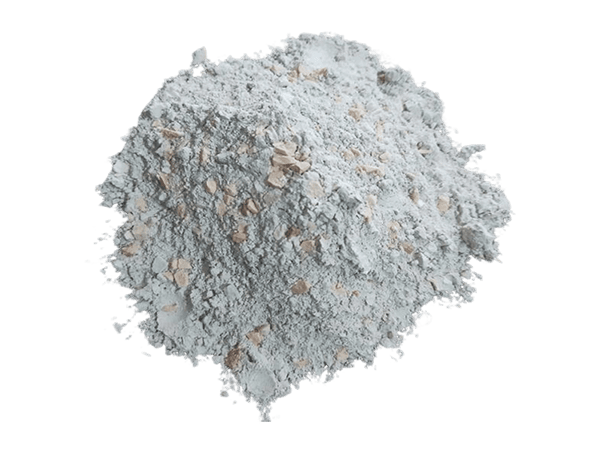
AZS Ramming Mass
Main composition: a mixture based on a baddeleyite-corundum aggregate.
Application
For lining bottom blocks and filling joints in the flame zone of glass melting furnaces that do not contact the glass melt; for lining and hot repair of silicate furnaces.
Description
Electrofused AZS ramming mass consists primarily of granules of electrofused baddeleyite-corundum aggregate. Its primary purpose is to create a bedding layer (also serving as a sealing layer), with a thickness of 75-120 mm, beneath electrofused AZS bottom blocks, as well as for the hot and cold repair of glass melting furnaces.
Electrofused AZS ramming mass contains approximately 20% glass phase. The presence of this phase in the series of electrofused AZS ramming masses causes them to become susceptible to creep deformation above 800°C. Within the range of 800–1300°C, the material’s plasticity and adhesive properties ensure joint sealing even under minor displacements and form a reliable intermediate layer with bottom blocks made of electrofused baddeleyite-corundum brick, which also contains a similar 20% glass phase. This effectively prevents the penetration of foamed glass melt between the bottom block and the bedding layer, eliminating “upward drilling” erosion, thereby helping to extend the service life of the furnace bottom.
Specifications
| Item | AZSC-5 | AZSC-06 | AZSC-04 | |
|---|---|---|---|---|
| Мак. размер зерна, мм | 5 | 0.6 | 0.4 | |
| ZrO2 % | 30~30.5 | 30~30.5 | 30~30.5 | |
| Al2O3 % | 48~49 | 48~49 | 48~49 | |
| SiO2 % | 18~20 | 18~20 | 18~20 | |
| Other Mixtures % | 2.5 | 2.5 | 2.5 | |
| Bulk Density (g/cm³) ≥ | 3.1~3.2 | 3.1 | 3.1 | |
| Crystalline Composition | Corundum (α-Al₂O₃) Baddeleyite Mullite Glass Phase (18-20%) | |||
| Glass Phase Liberation Temperature °C | 800~1200 | |||
| Plasticity Temperature Range °C | 800~1200 | |||
| Mullite Crystallization Temperature from Glass Phase °C | 1200 | |||
| Resistance to Soda-Lime-Silicate Glass Melt | Excellent performance characteristics up to 1400°C | |||
| Product Form | Dry Mix | |||
| Application | Base layer of hearth sealing: 35-80 mm | Base layer of hearth sealing: 10 mm | Filling joints between bottom blocks | |
Resistance to glass melt corrosion and metal penetration
| Item | Fused Cast AZS | Sintered AZS | Zircon Brick | AZS Ramming Mass | Zircon Ramming Mass |
|---|---|---|---|---|---|
| Glass Melt Corrosion Resistance Index | 100 | 35 | 25 | 50 | 15 |
| Metal Penetration Resistance Index | 100 | 35 | 50 | 50 | 50 |