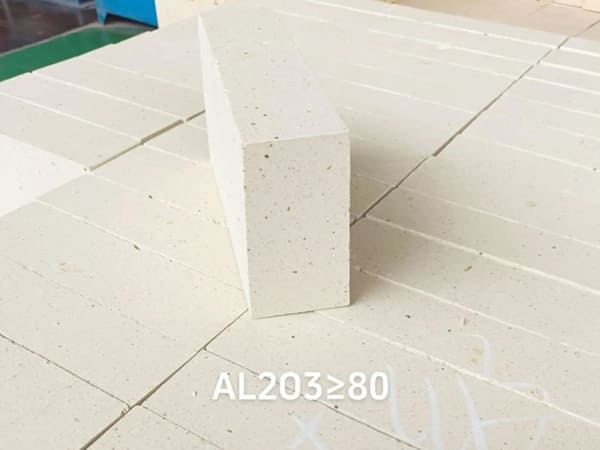
Super Duty High Alumina Brick Al 80 is a
premium-grade refractory product manufactured primarily from bauxite raw material through high-temperature firing. With an alumina oxide (Al₂O₃) content of approximately 80%, this brick combines exceptional thermal stability and corrosion resistance, making it an ideal lining solution for high-temperature equipment in metallurgical, cement, and other demanding industries. Produced from selected raw materials and fired at 1500°C using environmentally conscious technology, it guarantees reliable performance. Its durability reduces long-term operational costs, and intelligent maintenance practices can further extend its service life.
Key Properties
High-alumina refractory brick is a refractory material primarily manufactured from bauxite raw materials through high-temperature firing. In the designation of high-alumina bricks, the number “80” indicates that the alumina oxide (Al₂O₃) content is approximately 80%. This high alumina content imparts to the brick high refractoriness and corrosion resistance, enabling it to maintain structural stability under high-temperature conditions. High-alumina brick Al 80 also possesses good thermal stability (thermal shock resistance), meaning it is
resistant to cracking or spalling under rapid temperature fluctuations. This makes it suitable for application in industrial processes that involve frequent heating and cooling cycles.
High Refractoriness: Refractoriness reaches approximately 1800°C, allowing the material to maintain stability in high-temperature environments without softening or melting.
Excellent Thermal Shock Resistance: An optimized internal structure ensures structural integrity remains intact even under rapid temperature fluctuations, preventing cracking and spalling.
Good Chemical Resistance: High alumina content provides strong resistance to attack by acids, alkalis, molten metals, and other chemicals, enabling prolonged use in harsh industrial conditions.
High Strength and Abrasion Resistance: Exhibits high compressive and flexural strength, enabling it to withstand significant mechanical stress. Combined with good wear resistance, this ensures an extended service life.
Good Volume Stability: Low linear/volume expansion coefficient at high temperatures helps maintain the structural stability of furnace linings.
Technical Specifications
| Item |
Al-80 |
Al-75 |
Al-70 |
Al-65 |
Al-55 |
Al-48 |
| Extra |
Ⅰ |
Ⅱ |
Ⅱ |
Ⅲ |
Ⅲ |
| Refractoriness (International Standard) |
SK-40 |
SK-39 |
SK-38 |
SK-37 |
SK-36 |
SK-35 |
| Al2O3 % |
≥80 |
≥75 |
≥70 |
≥65 |
≥55 |
≥48 |
| Apparent Porosity % |
≤21 |
≤24 |
≤24 |
≤24 |
≤22 |
≤22 |
| Cold Crushing Strength MPa |
≥70 |
≥60 |
≥55 |
≥50 |
≥45 |
≥40 |
| Refractoriness Under Load 0,2 MPa °C |
≥1530 |
≥1520 |
≥1510 |
≥1500 |
≥1450 |
≥1420 |
| Linear Change on Reheating % |
1500°C×2h -0.4~0.2 |
1450°C×2h -0.4~0.1 |
Production Process
The manufacturing process of high-alumina brick Al 80 primarily involves the stages of raw material preparation, forming, drying, and firing. Selected bauxite is uniformly mixed with a binding agent after crushing and screening. The mixture is then pressed under high pressure in forming equipment to achieve the required shapes, such as standard bricks or shaped elements. The formed green bricks undergo natural drying or low-temperature drying to remove excess moisture. Firing of the green bricks takes place in high-temperature kilns, where the temperature is typically controlled above 1500 degrees Celsius to ensure the attainment of an ideal sintered state and the required performance indicators. The entire production process is oriented towards environmental friendliness and the rational use of resources, minimizing waste generation.
Areas of Application
High-alumina refractory Al 80 is primarily used as a lining for high-temperature industrial equipment, such as
metallurgical furnaces, cement rotary kilns, glass melting furnaces, and chemical reactors. In such equipment, it effectively resists high temperatures and chemical corrosion, thereby extending the equipment’s service life. It can also be used in
thermal boilers and certain components of the power industry to provide reliable thermal insulation and protection. When selecting high-alumina bricks, specific operating conditions such as temperature range, type of working medium, and mechanical loads must be considered to ensure optimal performance matching.
Daily Maintenance and Precautions
To ensure the long-term performance of Al 80 bricks, regular maintenance is crucial. During installation, standard operating procedures must be strictly followed to avoid mechanical damage to the bricks. During operation, the condition of the lining should be inspected regularly, and any worn or damaged sections should be replaced promptly to prevent leaks of high-temperature media. It is important to control the equipment’s operating temperature within a reasonable range, avoiding overheating or sudden temperature changes to minimize the impact of thermal stress on the brickwork. If issues arise, it is recommended to consult professionals rather than attempting to address them independently.
Economic Efficiency and Sustainability
The initial cost of Al 80 high-alumina bricks may be slightly higher than that of fireclay bricks. However, due to their durability and long service life,
the total cost of ownership is often lower. In industrial projects, this material helps reduce the frequency of repairs and replacements, thereby saving costs. The production process focuses on resource recycling and energy efficiency, aligning with the principles of sustainable development and reducing environmental impact.
Conclusion
In summary, high-alumina brick Al 80 is a reliable refractory material. Through rational production and application, it can provide effective support for high-temperature industries. We hope this article helps readers better understand this material and make informed choices in its practical application.