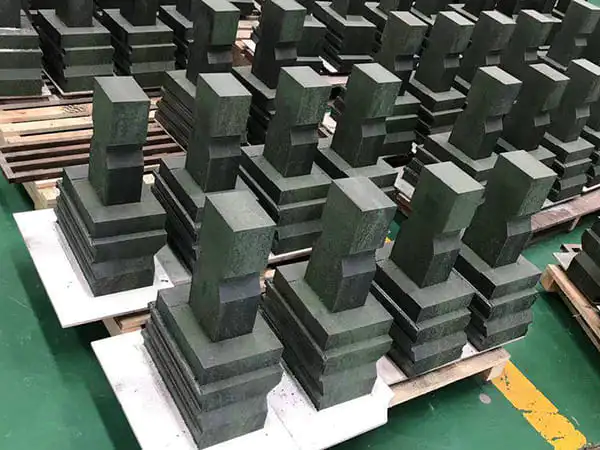
Isostatically Pressed Chromite Refractory Material
The main component of dense high-chrome bricks is Cr₂O₃, its mass fraction is usually more than 90%. Since pure chromium oxide (Cr₂O₃) is difficult to sinter, it is necessary to introduce a sintering aid TiO₂ or, if necessary, a small amount of ZrO₂. The main component, Cr₂O₃, imparts excellent corrosion resistance to dense high-chrome bricks, allowing their widespread use in areas of high-temperature erosion in contact with glass melt. The main reasons for this may be as follows:
Cr₂O₃ has an extremely low solubility in the glass melt.
The sintered material with a high Cr₂O₃ content has a large wetting angle with respect to the glass melt, meaning poor wettability.
The dissolution of Cr₂O₃ in the slag increases the viscosity of the slag melt, and the highly viscous slag, in turn, forms a protective layer on the refractory, effectively reducing the corrosion rate.
1. Technological Production Process and Features of Dense High-Chrome Bricks
The technological production process for dense high-chrome bricks is completely different from the production process of ordinary refractory products. They are manufactured using large-format ceramics technology, which includes fine grinding of raw materials, granulation, isostatic pressing, and firing in a neutral or reducing atmosphere. In essence, they belong to the class of ceramic refractories. Abroad, dense high-chrome bricks are divided into two types obtained by isostatic pressing: from fine powder and from granular masses. Both types of bricks are used in zones of contact with glass melt in tank furnaces for melting alkali-free glass fiber. Products molded from fine powder have better corrosion resistance, but their thermal shock resistance is lower. Products molded from granular masses have somewhat better thermal shock resistance, but their corrosion resistance is slightly inferior to products made from fine powder.
2. Raw Materials for the Production of Dense High-Chrome Bricks
The main raw material for the production of dense high-chrome bricks is technical grade chromium oxide Cr₂O₃ (commonly referred to as “chrome green”). Requirements: Cr₂O₃ content ≥ 99%, the particle size distribution must correspond to micro- or ultra-fine powder. The finer the particles, the better the sintering, but the lower the density of the molded blank and the greater the shrinkage during firing, which increases the risk of crack formation. To obtain granules with a higher bulk density, which contributes to achieving high density of the compact, it is preferable to use a charge based on dense Cr₂O₃, but only to the extent that it does not prevent achieving complete sinterability and densification of the product.
2.1 Additives
Cr₂O₃ is a difficult-to-sinter oxide. When fired in an oxidizing atmosphere or an atmosphere with high partial pressure of oxygen, sintering requires a temperature of no less than 1900 °C. The main reason is that under high oxygen partial pressure, Cr₂O₃ is prone to oxidation and change in valence. The resulting chromium oxides with higher oxidation states have increased vapor pressure and are easily volatilized. This causes the sintering process of Cr₂O₃ to transition from volume diffusion to mass transfer via the evaporation-condensation mechanism. This type of mass transfer usually causes abnormal growth of Cr₂O₃ crystals, preventing the effective removal of pores and the achievement of dense sintering, thus making it difficult to obtain dense high-chrome bricks. Therefore, in the production of dense high-chrome bricks, it is necessary to simultaneously apply two important technological measures: the introduction of sintering aids and the creation of an environment with low oxygen partial pressure during firing. Research on sintering aids for Cr₂O₃ material has yielded good results. Such additives include MgO, Al₂O₃, La₂O₃, CaO, TiO₂, and rare earth oxides. However, industrial-scale production shows that the most effective and relatively inexpensive additive is TiO₂. The titanium-containing raw materials used in production include titanium dioxide (TiO₂) with a main substance content of 99% (e.g., pigment-grade TiO₂) and titanium slag with a TiO₂ content of about 98%.
2.2 Forming
The forming of dense high-chrome brick compacts is carried out in a cold isostatic press. When designing molds for isostatic pressing, two main factors are considered: the size and shape of the elastic envelope (bag), as well as the material from which it is made. Once the shape of the envelope is determined, its dimensions (shrinkage allowance coefficient) are established depending on the properties of the material being pressed. When using plastic materials for the envelope, it can be assumed that the relative degree of compaction is the same in all directions. Currently, the main material for manufacturing envelopes is natural rubber. The granulated Cr₂O₃ material is portion-wise filled into the mold envelope until completely full and compacted on a vibrating table to ensure uniform powder distribution and remove some of the air. Then the envelope is hermetically sealed and tied with fastening elements. After this, the envelope with the granulate is placed into the working container of the cold isostatic press and pressing is carried out according to a specified regime. Upon completion of pressing, the compact is removed from the mold and left for natural aging or subjected to drying.
2.3 Setting in the Kiln
The compacts formed by isostatic pressing, after several days of natural aging, are placed in a dryer with adjustable temperature for drying. Only after thorough drying can they be set into the kiln for firing. If the compacts are fired in a fuel-fired kiln, the setting should be carried out using packaging and sealing. The sand bed of the kiln hearth is leveled with a layer of fine-grained material. The sand layer should be thick enough to reduce friction between the compact and the bed, which helps increase the yield of quality products. To equalize the temperature along the height of the setting, it is recommended to leave channels on the kiln hearth for the passage of hot gases (flues) during setting. This allows increasing the temperature of the lower part of the compacts, achieving uniform vertical shrinkage, and preventing cracking caused by uneven heating.
2.4 Firing
The firing atmosphere is crucial for the production of dense high-chrome bricks. As a rule, firing should be carried out in a reducing or neutral atmosphere. The main goal here is to control the partial pressure of oxygen in the gas environment. However, a strongly reducing atmosphere should not be used, as this can lead to the reduction of the main component — Cr₂O₃ — by carbon monoxide (CO) or carbon (C) to chromium carbides, which will negatively affect the properties of the products and the yield. The partial pressure of oxygen (pO₂) in the kiln should be maintained within the range of 10⁻¹⁰ to 10⁻⁹ Pa. Too low a pO₂ must not be allowed, since at an oxygen pressure below 10⁻¹² MPa (i.e., ~10⁻¹⁵ atm), Cr³⁺ ions can be reduced to Cr²⁺ or metallic chromium, and even form chromium carbides. At the same time, the partial pressure of oxygen should not be too high, otherwise Cr³⁺ will be oxidized to Cr⁴⁺, Cr⁵⁺, or Cr⁶⁺. The corresponding chromium oxides with higher valence are volatile and possess high vapor pressure. This leads to a change in the sintering mechanism of Cr₂O₃ from volume diffusion to mass transfer via the “evaporation — condensation” scheme. Macroscopically, this manifests as an absence of compact shrinkage and difficulties in sintering (high open porosity — ≥25%), and microscopically, as excessive growth of Cr₂O₃ crystals and the presence of large intergranular pores. All of this also seriously reduces the high-temperature strength and corrosion resistance of the products.
Conclusion
Dense high-chrome bricks, primarily intended for the lining of basalt fiber melting tank furnaces, possess unique resistance to corrosion by melts. Their application has made it possible to increase the campaign life of such furnaces from several months to two years or more. Due to the increasing demands for longer furnace service life, as well as for minimizing the volume of repair work and hot repairs (gunning) on particularly erosive areas, an expansion in the application of dense chromium oxide (Cr₂O₃) products in tank furnaces for melting soda-lime-silicate glass and in furnaces for producing basalt fiber can be expected.